Roscommon Reconstructions
Some pieces commissioned by Roscommon County Council with funding from the Community Monuments Fund 2020 last year, #CMF20. One is of a Court tomb and the other Portal tomb found in the county. It shows the possible other uses of tombs suggested by archaeologists, other than the usual ritual/burial uses.
When tombs of the Neolithic and beyond, are dealt with, the focus is often on the tomb part of their name. But there was only ever a small amount ever buried in these places. This raises the question of what did they do with the other people but more importantly for here, is what were the other uses for these sites if burial was only a small part? These sites were often very visible and obviously important to the community, so we have focused here on the communal possibilities of these tombs.
Knockranny Court tomb
Archaeological evidence shows that burials at these sites was only part of their story, as often they only contain a handful of burials, most likely sacred bones, rather than representative of population at large. These sites were often placed near the farmland of the builders sites and often placed in areas already sacred, either with previous activity or natural features. A tradition of narration would have been probable and mostly genealogical, perhaps using the landscape as a prompt in narration. Here we show this as the site is being used as a teaching tool. To teach the new generation about their ancestors and the world they inhabit, and their place in it.
As for the tombs themselves, court tombs generally had long cairns, usually trapezoidal or rectangular. 25-35m is the common while 40-60m is unusual. Usually the tombs had corbelled roofs, and cairn covering, though there is suggestions that they may have been roofed by timbers too. Court tombs in the west of Ireland are often aligned to the rising sun.
The sites may also have been places of ceremony, as liminal spaces between the living and the dead. The perception perhaps that the ancestors weren’t far off and inaccessible but still active. People could have entered a trance like state, to meet these ancestors. Hallucinogenic agents may have been used to reach these transcendent states. Not necessarily though, as long periods of dancing, loud music and chanting have been known to induce hallucinations, or another world experience. During these ceremonies they could have had a strong emotional experience separate from the every day life, allowing society to break out of its bonds, for people to act in ways they would not usually.
The clothing in both of these are based on the find of Otzi, a wounded man who died crossing the alps and was frozen for millennia. Besides this these clothes were altered and added to based on evidence from historical & modern evidence from hunter gather & farming groups around the world. There is also an element of local in the clothing, with local animals of the time used, like fox, bear, wolf, goat, dexter cow etc.
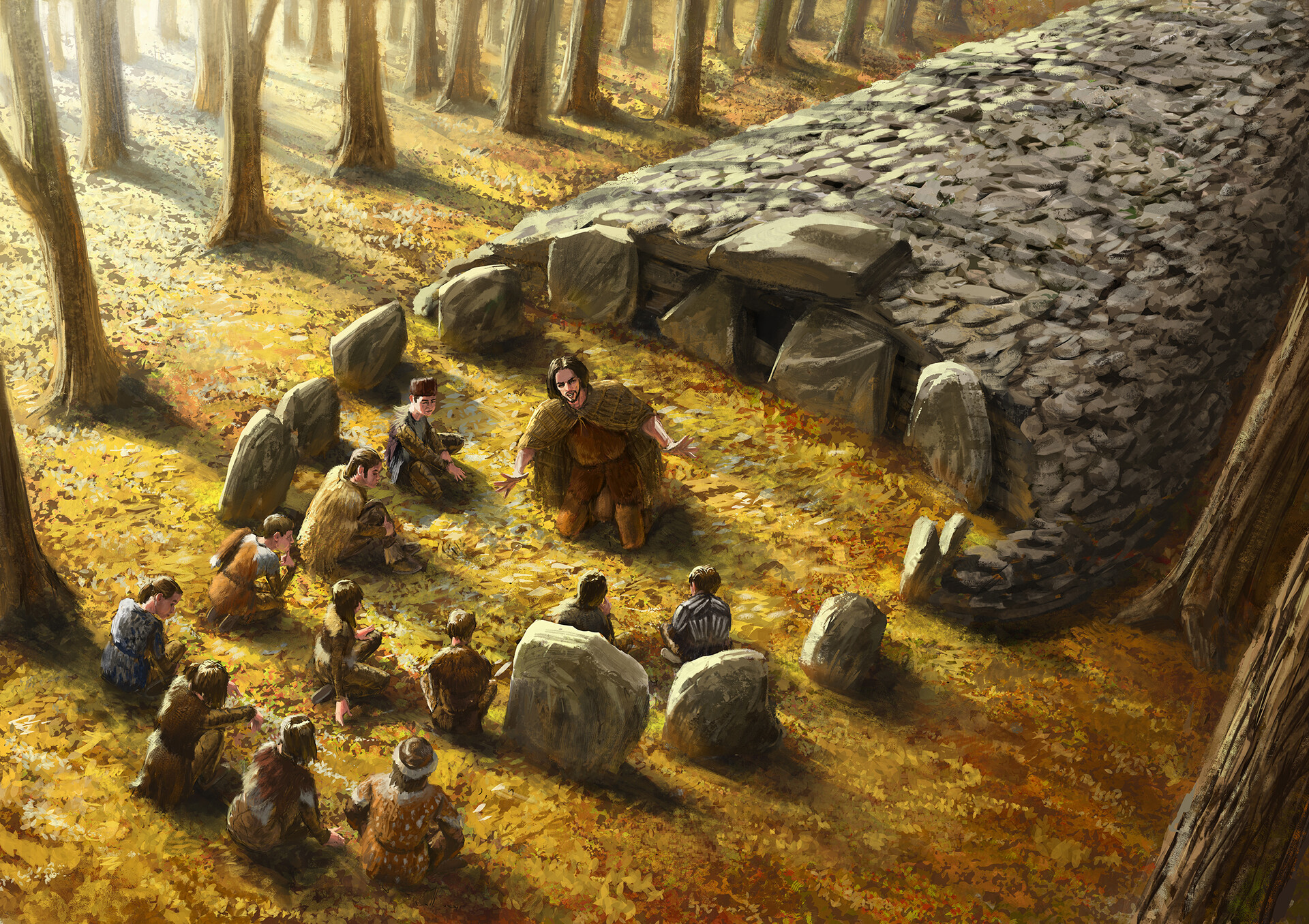
Knockranny Court Tomb